

Inquiry
Inquiry cart car is empty.
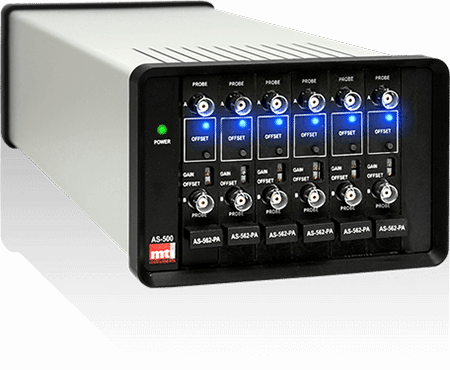
Compact by design, the Accumeasure TM 500 capacitve sensing sensor is ideal for in vehicle testing of brake rotors, axle runout, or thermal expansion testing using the DC model. Multiple racks may be synchronized together for multichannel operation on a common surface to avoid inter-channel interference.
The Accumeasure TM 500 compact multi channel capacitance rack system accepts up to 6 capacitance amplifiers. Capacitance sensors are used to measure position, thickness, dynamic motion, vibration, run-out of conductive and semi-conducting materials where high resolution and accuracy of up to sub nanometer are required. Select from the standard AS-563 (for grounded targets) or the proprietary push/pull AS-562 (ungrounded targets) in any combination.
The modular design allows customers to populate the rack with their required number of measurement channels for thickness or single ended displacement measurements.
Ask about adding Master/Slave switch to amplifier for multiple ampifer synchronization, if required.
The Accumeasure AS-500 sets new standards in non-contact measurement. It’s a high-precision tool that offers a range of unique features designed to streamline and improve your measurement processes. Its primary feature is its high-frequency response, which allows for swift and accurate measurements. The system also provides an analog output that can be easily integrated with other systems, enhancing its versatility. Furthermore, its compact design ensures it fits seamlessly into your workspace.
Our Accumeasure AS-500 is a compact modular rack system that can hold up to six measurement channels or summing amplifiers. This feature makes it highly adaptable to your specific needs and enables it to deliver precise measurements across multiple channels simultaneously. Moreover, the system is built on the parallel plate capacitor measurement principle, ensuring the highest accuracy.
The brake rotor, also known as a brake disc, plays a pivotal role in vehicle safety. Given its crucial role, accurate brake rotor thickness measurement is critical. That’s why you need tools like our Accumeasure AS-500 if you want proper readings that don’t limit the effectiveness and growth of your operations.
Accurate brake rotor thickness and axle runout measurement are crucial in the automotive industry, especially for vehicle manufacturers. Capacitive sensing offers a reliable method to achieve this precision. Capacitive sensors monitor the distance between the brake rotor and a probe while the rotor is spinning, improving the quality of brakes, reducing manufacturing defects, and delivering on safety standards.
The use of capacitive sensing can significantly reduce rotor runout, pedal pulsation, uneven wear, and brake job comebacks, leading to lower maintenance costs and improved customer satisfaction. Capacitive sensor output is also clean and accurate, overcoming the limitations of built-in measurement systems in some drilling machines.
Accurate evaluation of brake rotor runout is also very important for diagnosing the extent of issues and determining the appropriate remedial actions. To accurately measure against the minimum thickness, the use of a micrometer at different points on the rotor is recommended. The insight from these measurements can aid in preventing brake pulsation before it starts, thereby enhancing the overall performance and longevity of the vehicle’s brake system.